
Welcome back after the summer break! At this time of year, leadership teams begin looking towards the final quarter and the year ahead. There will be strategy days, planning meetings and presentations filled with priorities, targets and ambitious language about where the organisation is going next. People will gather around tables, discuss the plan and eventually agree that everyone is aligned.
I have started to wonder whether they are.
There is a question I increasingly find myself asking leaders: does everyone have the same Flightplan? Not whether everyone has seen the strategy, or whether it has been presented clearly, uploaded to the shared drive or condensed into a set of attractive slides. If I spoke to each person separately and asked them where the organisation was going, what mattered most and what they were expected to do next, would I hear the same answer or several different versions of the plan, all delivered by people who genuinely believe they are aligned?
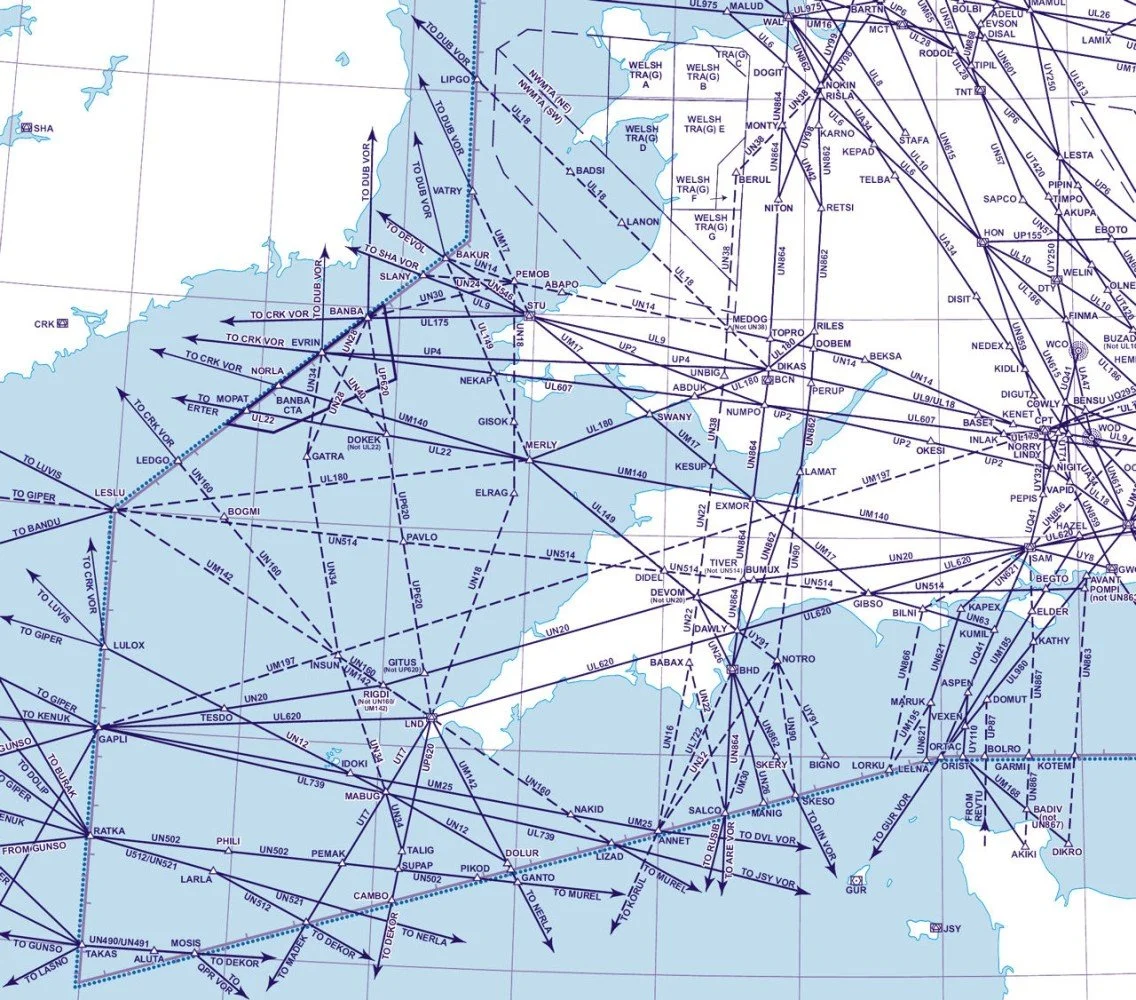
These are the airways over the South-West Coastline of the UK - several of them lead to the same place but in different directions and all with different consequences
A flight plan is only the beginning
In aviation, a flight plan sets out where the aircraft is going and how it is expected to get there: the route, the altitude, the fule, the alternates. It reflects the weather, airspace restrictions, aircraft performance and anything else likely to affect the journey. It matters enormously. What it does not do is create a shared understanding of the flight. That happens in the briefing.
Before departure we talk through what we know, what is different, what could change and where the threats might be. We consider the weather at our destination and what our plan will be if it deteriorates, we discuss technical issues, operational constraints and anything unusual about the departure or arrival. The point is never to just read this information off that everyone can already see, it is to make sure we have all interpreted it in the same way.
This isn't reserved for special occasions. On a typical short-haul day we might fly four sectors, usually with the same crew, and mostly (but not always) on the same aircraft, to places we have visited hundreds of times before - but we still brief every sector. Nobody ever suggests skipping it because we have already completed one that morning or have flown that route countless times before. Conditions change, aircraft change, and people change, so the shared understanding has to be rebuilt every time. We also "debrief" - so we review what has happened on the previous flight and carry anything relevant into the next sector. Compare that with most organisations, which debrief the plan once a year at their strategy day and then wonder why interpretations have drifted by March. (Not you of course dear reader - but people you know!)
“The document gave us the route, but the briefing gave us the shared Flightplan. ”
Two people can read exactly the same information and reach quite different conclusions about what it means, and that is where many leadership teams begin to drift.
Agreement is not the same as alignment
Most organisations do not suffer from a complete lack of strategy. They suffer from different interpretations of it. One leader hears "growth" and begins looking for new markets. Another hears "growth" and focuses on increasing revenue from existing clients. Someone else concludes the organisation needs more people, while the finance team believes the same plan requires tighter control of costs. Everyone is working hard, everyone believes they are supporting the strategy, everyone can point back to the same presentation - but everyone is flying on different routes!
The problem is not necessarily disagreement - that would be easier to deal with because it is so obvious. The problem is the assumption that agreement exists because no one challenged the plan when it was presented. People nodded, the meeting ended, the slides were circulated....That can look like alignment but it might simply mean that everyone left the room carrying a different version of what has just been agreed.
Real alignment becomes visible later, through the decisions people make when the person who presented the plan is no longer in the room. Which work receives attention, what gets delayed, where resources are allocated, what happens when two priorities compete, what people are willing to stop doing... It is in those ordinary, unsupervised decisions that the true Flightplan emerges.
The destination is not enough
A team can agree on a destination and still be completely misaligned about how to reach it. Imagine a flight crew agreeing they are flying to Geneva but never discussing the weather en route, the fuel available, the possible diversion airports or the point at which continuing would no longer be sensible. The destination is clear, the plan is not.
The same thing happens in business - words such as growth, transformation, customer focus, efficiency and innovation describe destinations but they don't tell people how to make decisions along the way. If customer experience and cost reduction come into conflict, who wins? If the organisation wants growth but is already operating at capacity, what will it stop doing? If speed matters, where is the team allowed to accept more risk, and where is it not? If circumstances change, who has the authority to alter the route?
Until those questions are answered, people are left to fill in the gaps themselves. Capable people are very good at filling gaps (it is part of what makes them capable), they use their experience, their instincts and their understanding of what the organisation values. The problem is that they will not all fill them in the same way which is why alignment can't be created simply by repeating the destination more loudly. Leaders need to make the decision-making logic visible as well (I am a big fan of crayon by the way - if you can explain it to me in crayon, it means that you understand it really well and I can then understand it better too - let's use more crayons!)
What a useful briefing does
A good briefing doesn't remove judgement from the people involved, it gives their judgement somewhere to take off from (pun intended). On the flight deck I didn't want a First Officer who simply repeated my words back to me and agreed with everything I said, I wanted someone who understood the plan well enough to recognise when we were drifting away from it. That meant they needed to understand (in crayon if necessary) not only what we were doing but why, which parts of the plan were fixed, which were flexible and which would cause us to reconsider. They also needed to know that if they saw something differently, I expected them to say so.

Can you explain it in crayon? If not, your team might not be understanding the destination properly
The same should be true in a leadership team. A genuinely shared Flightplan lets people answer four questions:
Where are we going? Not the slogan, the specific outcome we are trying to achieve.
What matters most on the way there? The priorities that will guide decisions when everything can't be done at once.
What could cause us to change the plan? The assumptions, risks and conditions that need to be monitored.
What is my role in making this happen? The decisions each person owns, and when they need to involve someone else.
If different members of the team give materially different answers, you do not yet have one Flightplan.
“You have several plans travelling under the same title.”
Alignment does not mean uniformity
There is a danger that alignment becomes another word for compliance - and it shouldn't. A well aligned team can contain different opinions, competing perspectives and vigorous challenge - in fact, I would argue that it should contain these things. On a flight deck, both pilots are looking at the same information through slightly different lenses, and that is really valuable because it means assumptions can be tested and risks spotted before they become problems. The objective is not for everyone to think identically - rather, it is for everyone to understand the destination, the priorities and the boundaries well enough to contribute their judgement without pulling the organisation in a completely different direction.
“A shared Flightplan does not remove disagreement, it makes disagreement useful. ”
When people know what they are collectively trying to achieve, they can challenge the route without destabilising the flight. Without that shared understanding, challenge feels personal, priorities become territorial and every disagreement risks turning into another debate about where the organisation is going.

This section appears in every issue: a real-world situation that comes up again and again, and a way of thinking it through that brings you back to centreline.
"Our leadership team has spent months developing its strategy. It was launched at an internal event, explained by the CEO and supported by a detailed presentation. The feedback was positive and everyone appeared to be really excited by it. Several weeks later, progress is uneven. Teams are making decisions that contradict each other, resources are being pulled in different directions, some people are still working to their previous priorities while others have interpreted the new strategy as permission to change everything immediately. The leadership team is frustrated saying "we have communicated the strategy, what aren't people following it?"
The first thing I would ask here is whether communication has been mistaken for transmission.
“Presenting information is transmission, real communication means finding out what has been understood.”
Instead of explaining the strategy again (in a louder voice?!), ask people to describe it back to you in their own words (remember the crayons?). What are we trying to achieve? What are the three most important priorities? What should we stop, postpone or do differently? When two priorities conflict, which one is the biggest and how should we decide that ? What does this mean for the decisions you will make this week?
Don't treat different answers as evidence that people were not listening - treat them as data. They show you where the plan is clear, where assumptions have filled the gaps and where another conversation is needed. The purpose is not to catch people out, it's to discover whether everyone is using the same Flightplan and understanding it in the same way before the differences become expensive.
Before you ask whether people are ready for take-off:
Energy matters. A strong launch can create momentum, signal change and bring people together around a shared ambition. The real test of a strategy though, is not how energised people are when they leave the room, it's whether they make better, more aligned decisions when the pressure returns in a few weeks time, or the next day, or just before they are about to go on leave. That required more than a destination, it requires a shared understanding of the route, the priorities, the risks and the decisions people are trusted to make along the way.
Before you ask whether your team is ready to take off into the final quarter, the next project, or 2027, ask a better question: Does everyone have the same Flightplan? (and does everyone understand it in crayon?!)
“An organisation doesn’t drift off course when people stop working hard, it drifts when capable people work hard towards different interpretations of the same plan. ”
Sometimes the most valuable thing a leader can do is pause before departure, bring everyone back into the briefing and make sure the plan that feels completely clear in their own head is equally clear to everyone expected to deliver it.
If this resonated, forward it to someone responsible for turning strategy into action - better still, before your next leadership meeting ends, ask everyone in the room, if we all described the Flightplan now, would we all end up in the same place at the end?
I work with leaders and organisations to apply flight-deck thinking to the decisions, pressures and team dynamics they are facing right now, If your leadership team has a destination but needs a clearer shared Flightplan, let's explore working together!