
How Do You Keep Good Looking Good?
Every quarter is a new landing
One of the most misleading phrases in aviation is "You're only as good as your last landing" - it sounds as though a good landing buys you something. In reality, by the time the passengers are leaving and the aircraft is being prepared for its next flight, that landing is already over.
On a typical short-haul day we would fly four sectors, or two longer ones, and every flight had to being again. Once we had debriefed anything worth carrying forward, the previous sector was done. We loaded the next Flight Plan, checked the weather and alternates, recalculated the performance figures and weight and balance, decided how much fuel we needed, completed the walkround, and briefed the next departure. Somewhere in the middle there might be time to help the cabin crew clean, have a wee, and if we were lucky, make a cup of tea.
None of that changed because the previous flight had gone well. We never decided that the last sectors preparation had been excellent, so this one could be abbreviated. Each new flight meant another opportunity to get thousands of ordinary decisions right.
The previous result was useful information. It was not credit we could spend on the next flight.
Last month I asked whether everyone had the same Flight Plan. This month I am asking what keeps that plan alive once the first success is behind you?
The more difficult leadership decision
Earlier this year I was invited to work with a large, well known bank, after three successful years of delivering their five year strategy. The year ahead had been described as one of "focussed ambition" and their challenge was not how to repair something visibly broken. It was much more interesting than that: how do you keep good looking good?
It is a question more successful organisations should ask. Failure usually announces itself and creates permission to change. Success is less obtrusive. It can persuade capable people that the habits, systems and attention that produced it are now simply part of the scenery, so standards are assumed, small shortcuts become normal and gradual drift is mistaken for confidence.
At the event, I asked whether anyone knew how the bank had started. Nobody in the room did apart from me, which was convenient because I was holding the microphone! My highly condensed version was it came about when one Quaker said to another "can you lend us a fiver?"
The more accurate account begins in 1690, when John Freame and Thomas Gould, both Quakers, began trading as goldsmith bankers in Lombard Street in London. In 1728, the business moved to premises identified by the sign of the Black Spread Eagle. The eagle remained, even as the organisation, its name, and the way it presented itself continued to evolve.
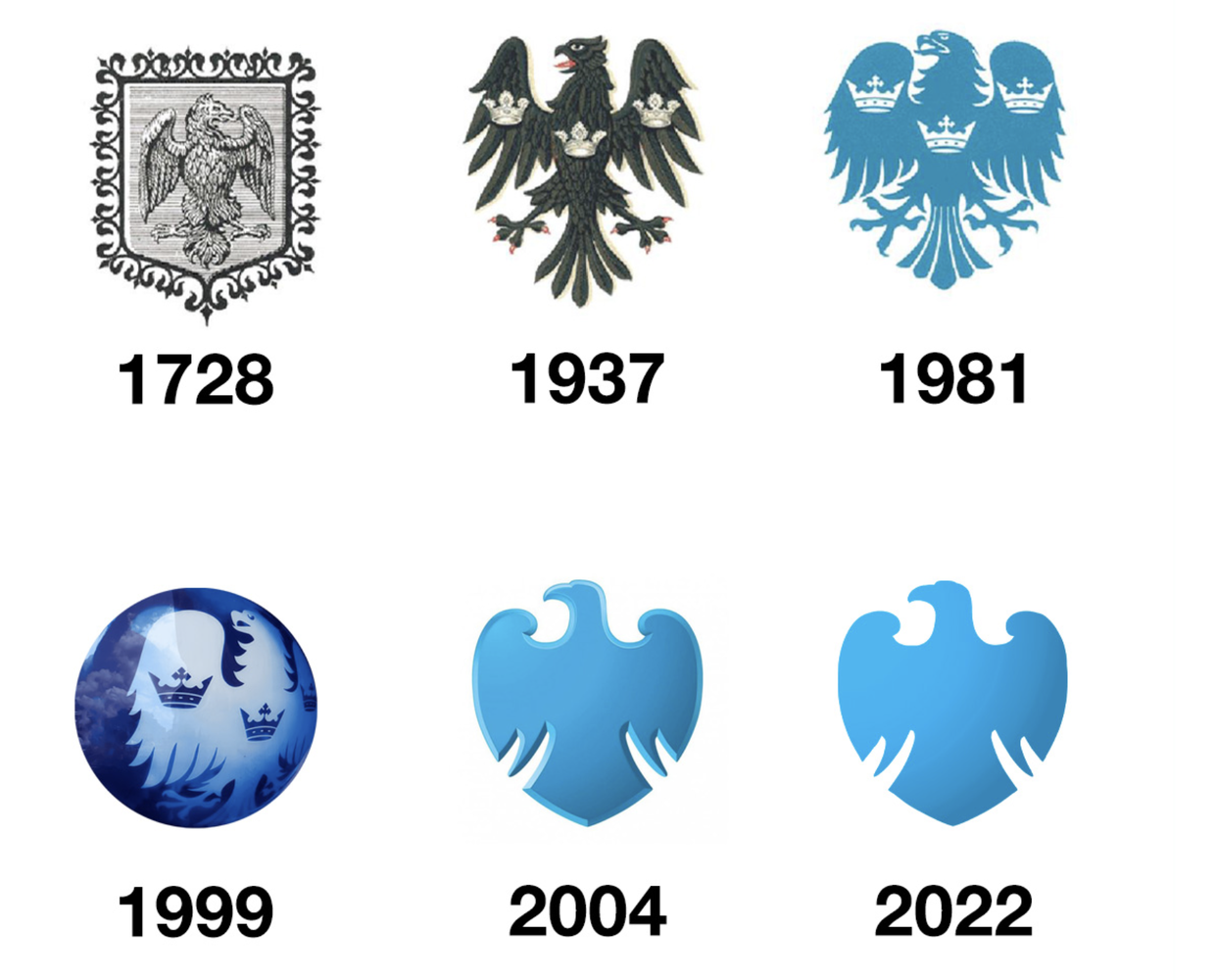
The Barclays eagle has evolved repeatedly while remaining recognisable
That is the distinction successful organisations must keep making. The mission and the method are not the same thing. Remembering what you are there for gives people an aiming point. It does not require you to preserve every process, product or assumption that once helped you reach it.
The mission stays, the method evolves
Theodore Levitt made the point memorably in 1960, when he argues that the American railways declined because they believed they were in the railway business rather than in the transportation business. They invested deeply in tracks, rolling stock and the business of running railways, and when other industries found different ways to move people, protecting the method turned out not to be the same thing as protecting the mission.
Many of those passengers ended up on aircraft, and if that industry had not evolved, and constantly considered what it was there to do, we would never have reached space flight and exploration - worth thinking about for a second....
That matters in any organisation with a proud history and a strong record. Past success can tempt people to defend what worked rather than remain curious about what the mission requires now. Keeping good looking good is not about freezing a successful organisation in place, it is about knowing what must remain constant and being brave enough to evolve everything else.
Aiming is not the same as arriving
Towards the end of sessions I run on this, I put a target at the front of the room and give everyone a simple instruction: choose something, and fly it towards the target. I had left out paper, model aircraft and other materials, but I deliberately said nothing about what they had to throw, or that it should be shaped like an aircraft. The only condition is that it must fly.
Most people make paper aeroplanes. They line them up, aim them carefully, and launch them with confidence. The aircraft the do what paper aircraft often do, each one finds entirely it's own interpreatation of the Flight Plan - often I should add, with hilarious consequences!
On one occasion however, one person looked at the materials, screwed a pieve of paper into a ball and threw it straight at the target - which it hit (whether a ball of paper technicially flies is a debate I am happy to have with any aerodynamicist - it basically becomes a missile and we know they fly with great accuracy - and it certainly arrived!)
This person had not ignored the instruction. They had understood it precisely.
The target was clear, the method was open. That distinction is essential if we want people to use their judgement rather than wait to be told every move. Too little clarity creates chaos, but too much prescription can stop people seeing a simpler or better way to achieve the outcome.
The exercise also demonstrates something less comfortable. However accurately people believe they have aimed, once their aircraft leaves their hands, other forces act upon it. The folds may be slightly uneven, the release may be imperfect, the air moves and the trajectory changes.
“Intention does not guarantee arrival”
The 1 in 60 rule
In aviation, the 1 in 60 rule gives us a useful approximation: for every degree an aircraft travels off course, after 60 nautical miles it will be roughly one nautical mile away from where it intended to be. One degree does not look dramatic at the beginning. Leave it uncorrected for long enough though, and it takes you somewhere else.
Good teams rarely become poor teams in one spectacular moment (and to be clear, the team I was working with in the video was absolutely not a poor team!). More often the briefing becomes slightly less thorough, a small assumption goes untested, an awkward conversation is postponed or a standard is allowed to soften because the results still look good. Each deviation appears too small to matter on its own. Together, over time, they change the destination.
“That is why small, deliberate corrections matter so much”
They keep performance aligned with purpose while there is still time to influence the outcome.

This section appears in every issue: a real-world situation that comes up again and again, and a way of thinking it through that brings it back to the centreline
"We have had three strong years and our business is in good shape. I want our kick-off to create energy, but my team are tired of being told everything has to change. How do we run it without implying something is broken?"
My first question would not be how to make the event inspiring. It would be what people need to see more clearly when they leave. I would start with four questions:
Q: What are we ultimately here to achieve?
Q: Which standards cannot be allowed to drift?
Q: Where do people have freedom to change the method?
Q: How will be notice the small deviations and correct them before they compound?
A kick off can give people a clearer target, a shared Flight Plan and permission to think differently about how they reach it. It can reset the standard. It cannot make the corrections for them one the room has emptied and normal work resumes.
Bring it back to Centreline
Success deserves to be recognised, but it must never be allowed to do tomorrow's thinking for us. In aviation, every landing is a new event, and every flight demands it's own preparation, it's own attention and it's own decisions. Business is no different.
“Every quarter is a new landing”
The useful question is not simply what worked last year. It is whether we remain clear about what we are aiming for, whether we are bold enough to evolve the method, and which small corrections we need to keep making now. This is what Grounded Leadership looks like in practice: clear about the destination, flexible about the route and disciplined enough to keep correcting.
If you are planning a 2027 kick-off, the question is not only how you will energise the room, it is what your people will understand, protect and do differently when the conference lanyards have gone in the bin and the pressure returns in the normal working week.