
Some years ago ITV filmed a documentary series called Inside the Cockpit, and one of the mornings they captured happened to be mine (nothing sharpens your commitment to doing everything properly like a camera crew watching you do it). I'd arrived at Inverness early after a night stop spent in my own bed, one of the great luxuries of flying from your local airport, ready to operate the first flight of the day to London. A full aircraft, mostly commuters, every one of them with somewhere to be by mid-morning.
The aircraft had other ideas. During our preparation we picked up a wingtip brake fault, so my first stop was the manual, because some faults can be reset from the flight deck. This one couldn't. The more complex procedures belong to the engineers, so an engineer was what we needed, and here my local airport earned its keep a second time because I had his number in my phone. I called Ops, checked they were happy for me to ring him directly, and did exactly that.
While he worked, I did what I could usefully do, which at that point was not technical. I moved through the cabin with water to help the cabin crew, and I spoke to the passengers several times, telling them where we were, what was happening, and what would happen next.
“It also let me gauge the mood of the cabin, which is information you cannot get through a closed flight deck door.”
We left about ninety minutes behind schedule with the fault fixed, and here is the part people find surprising: the passengers were happy. Not resigned, not simmering, happy. For ninety minutes they had been looked after and kept informed, and at no point did they feel that nothing was being done - although from their seats, for long stretches, that is exactly what it must have looked like. No engines running, nobody going anywhere, everyone waiting.
Everything was happening. We just weren't moving yet.
“From the outside, that morning looked like being stuck on the ground. It wasn’t. It was being grounded, and the difference between those two words deserves far more attention than it gets.”
Grounded is a decision. Stuck is the absence of one.
In aviation, grounded has a precise meaning. An aircraft is grounded when it is deliberately withheld from service because the conditions for safe operation haven't been met yet. It is not idle. Behind it there is a procedure running, a timeline being worked, a decision point coming. That morning at Inverness we were grounded in exactly that sense: a fault identified, a manual consulted, an engineer on his way, a sequence with an end.
“Stuck is different. Stuck is when nobody is working the problem. No procedure, no timeline, no decision point, just waiting and hoping something changes on its own.”
From the outside, the two can look identical. A team not hitting deadlines. A decision not being made. A leader who seems calm about a stalled project. But one of those is composure with a plan underneath it, and the other is composure because nobody is willing to say out loud that there isn't one.
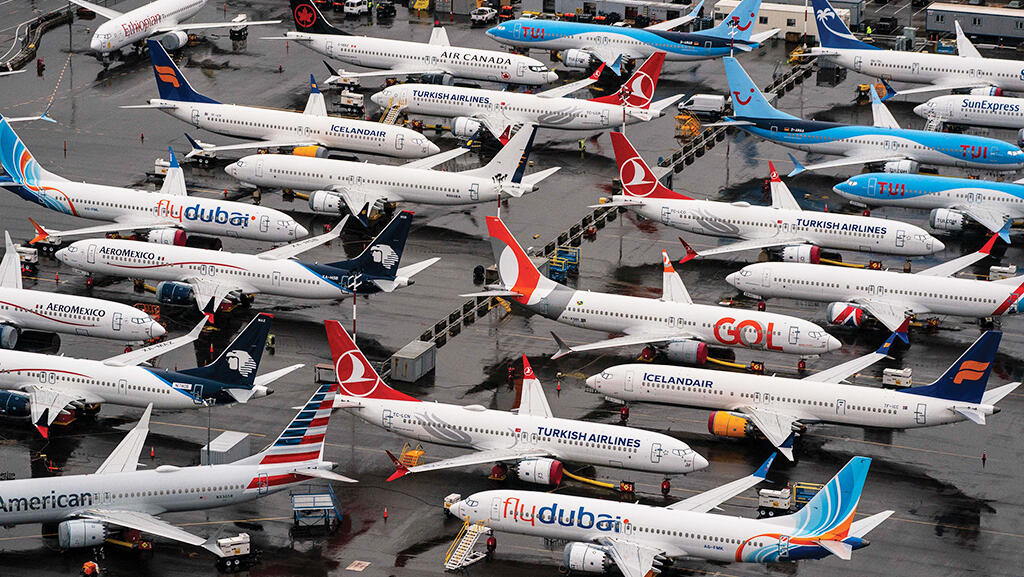
Grounded and Stuck are two different things
Where leaders slide from grounded into stuck
I see this constantly in the organisations I work with, and it never announces itself. It starts with a genuinely sensible pause. Waiting for more data, waiting for a key stakeholder, waiting for the market to settle. All reasonable, all grounded.
Then the pause outlives its reason. The data arrives and nothing changes. The stakeholder weighs in and the decision still doesn't move. The market never fully settles, because markets don't. What began as a deliberate hold becomes a default state, because stopping to admit "we don't actually have a plan for restarting this" feels harder than continuing to wait.
That is the tell, and it is worth writing down somewhere you'll see it. Grounded has an exit condition. Stuck doesn't.
Every grounded aircraft has a documented reason for being where it is and clearly defined conditions for returning to service. At Inverness I could have told any passenger on board exactly what needed to be true before we moved: the fault reset, the engineer satisfied, the doors closed. Leadership deserves the same rigour. In recent issues I've written about turbulence as the operating system and about acting without certainty. This is the other half of that same discipline, because knowing when to hold is a decision of exactly the same weight as knowing when to move, it just gets far less credit.

This section appears in every issue: a real-world situation that comes up again and again, and a way of thinking it through that brings you back to centreline.
"We paused a major decision three months ago to wait for better numbers. The numbers came in, and we're still sitting on it. I keep telling my board we're being prudent, but honestly, I'm not sure we are anymore."
The honesty in that last line is doing a lot of work, so let's use it.
Start with the original condition for moving again. Not the vague version, the specific one. "Better numbers" isn't a condition, it's a mood. What number, by when, would have told you it was time to act? If you can't answer that, you never set an exit condition at all, you set a feeling, and feelings don't expire on schedule.
Then ask whether that condition has now been met. If it has and you still haven't moved, you are no longer grounded. You are stuck, and prudence is the story you're telling yourself so it doesn't feel that way.
Finally, ask what it would cost to say that out loud. Usually far less than people fear. Boards tend to respect "the condition we set has been met, and here is what we're doing about it" a great deal more than a leader extending an invisible deadline. And if the spell still won't break, borrow a trick that almost always works: if someone you rated brought you this exact situation, what would you tell them to do? It is remarkable how easy stuck is to spot in someone else's business.
Grounded is a pause with a plan and a horizon. Stuck is a decision you've stopped admitting you haven't made.
Bringing it back to centreline
That aircraft left Inverness ninety minutes late, but it left, and it left with a cabin full of people who felt looked after rather than abandoned. Nobody remembers the delay.
“What gets remembered, always, is whether someone had a plan and whether they told you about it.”
Being grounded is not the opposite of moving forward. Sometimes it is exactly what moving forward responsibly looks like from the outside. So two questions worth sitting with this week. Does the pause you're in still have a plan attached to it? And if it does, could you say out loud, in one sentence, what would tell you it's time to move?
If this resonated, forward it to someone who has been waiting for the right moment for a little longer than feels comfortable, and ask them what their exit condition is.
I work with leadership teams to build this kind of clarity into how they operate under pressure, not as a one-off session but as a way of thinking that holds. If your organisation has a decision that has been on hold for longer than anyone is comfortable saying, let's talk.
No pressure or obligation. Just a place to think clearly.
Keep it on the centreline.