
“The problem isn’t always that people aren’t doing their jobs. Sometimes, it’s that everyone is doing their job, but nobody has joined the dots.”
At six o'clock one morning I arrived at Luton airport to operate a flight to Tel Aviv, only to discover that our planned aircraft had been swapped.
Nothing unusual there - aircraft swaps happen. Sometimes they’re straightforward and the passengers barely notice, but this one came with a bit of a significant complication.
Going through the paperwork, I noticed that the replacement aircraft was registered with a maximum take-off weight four tonnes lower than the aircraft we’d originally planned to use. Physically, it was capable of carrying the same load, but the paperwork said otherwise, and in aviation you cannot simply ignore a limitation because you know the aircraft could manage it in theory. I rang operations to point it out, and there was silence on the other end of the phone as the penny dropped. We needed to lose four tonnes (and even by my January, post holiday standards, thats a lot!)
There were options, but none of them really worked well. We could reduce the fuel load and plan a technical stop somewhere en route, possibly Milan, to take on more fuel, or we could offload passengers, which, by my calculations, meant telling around forty people that they weren’t going to be travelling with us. Neither of those options was going to be popular, and neither was going to get us away on time.
What happened next was a considerable amount of problem-solving. I was based at my airlines epicentre, so I was able to gather representatives from crewing, operations, engineering and flight planning so that we could work through the possibilities together rather than spend the morning passing messages between departments. We discussed the constraints, considered what was achievable and worked out a plan. Everyone had a job to do, and everyone got on with it, so from an operational perspective we were making progress.
There was just one problem. Three hours into this exercise, we discovered that nobody had told the passengers what was going on. We had been so occupied with solving the aircraft problem that we’d overlooked the people who were supposed to be travelling on it.
That, to me, is one of the most revealing things about teamwork. Nobody had deliberately ignored the passengers, and nobody was being lazy or obstructive.
“We had a collection of competent people concentrating on solving their individual parts of a complicated problem, but we hadn’t joined all those parts into one complete picture.”
We eventually got the communication right. I decided to confront the problem directly by going to the gate and speaking to the passengers to explain not only what had happened, but what was going to happen - when I asked my crew if they would be willing to come with me, every single one of them said yes. We arranged for translators for those who didn't speak English as their first language, and we stayed and answered every last question the passengers had for us.
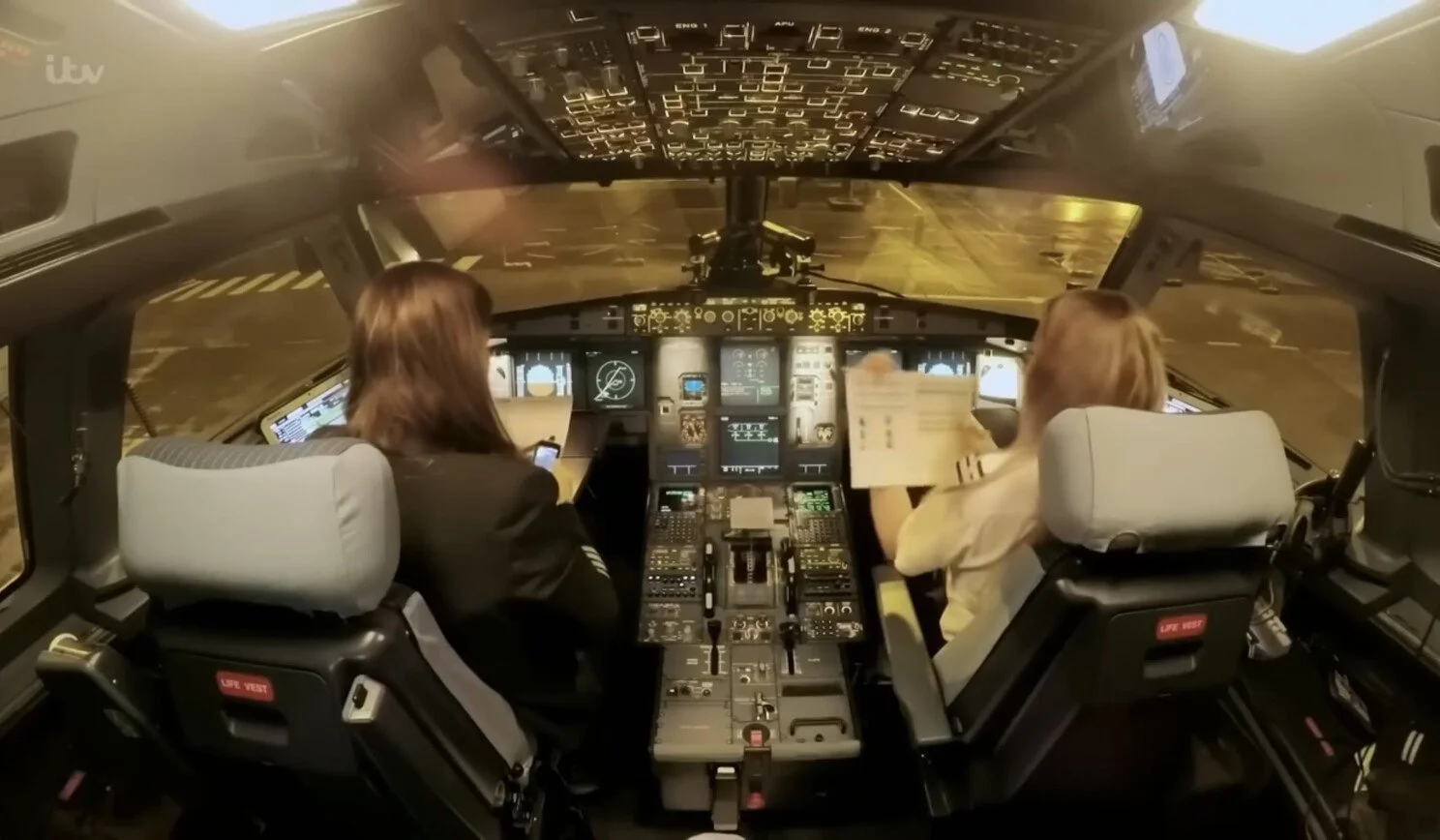
Instruments, people and the outside view each provide part of the picture
In the end, we waited for the original aircraft to return from wherever it had been sent, which was a manageable delay, but it put my crew and me out of hours to operate to Tel Aviv and back. So we flew the aircraft and passengers as far as Milan, where a crew from there took over and flew them on to Tel Aviv, while the rest of us were put on different flights back to the UK wherever there was space. (I made sure everyone else had left Milan before I did, obviously.)
The passengers experienced a substantial delay and a change of crew halfway through their journey, but they clapped and cheered as we told them we were finally ready to go, again when we landed, and again when we left the aircraft having handed them over to a Milan crew to complete their journey. Some of them subsequently wrote to the company to thank the crew for their efforts which I know because the CEO emailed me to tell me.
The disruption hadn’t changed - we had still been late, and we had still inconvenienced a lot of people. What changed was their understanding of what was happening and how we were trying to resolve it.
The technical problem mattered, and the operational solution mattered, but so did the experience of the people at the other end of our decisions. Until we’d considered all three, we hadn’t really solved the problem at all.
The danger of everyone doing their own job
I have been thinking about this a great deal recently, particularly in conversations with organisations about culture, accountability and the way teams work together.
We tend to think of poor teamwork as people not cooperating, not communicating or not pulling their weight. Sometimes that’s true, but some of the most significant organisational problems occur when people are doing precisely what they’re supposed to be doing.
“Some of the most significant organisational problems occur when people are doing precisely what they’re supposed to be doing.”
Finance is protecting the budget. Operations is keeping things moving. Procurement is securing the best commercial terms. HR is looking after people. The leadership team is concentrating on strategy. Each department has its own priorities, pressures, measures of success and deadlines. Individually, they may all be performing exceptionally well. Collectively, they may be creating a problem that nobody can see.
The difficulty with organisational silos isn’t necessarily that people are unwilling to share information. It’s often that they don’t realise the information they hold is relevant to somebody else’s decision.
The finance team doesn’t know what the operational team has promised. The operational team doesn’t understand why procurement has changed a specification. The people delivering the work know there’s a problem, but nobody has asked them because the management reports are all green.
“Everyone is looking at a different piece of the same puzzle, and each assumes somebody else is looking at the finished picture. That assumption can be expensive.”
What the flight deck taught me about the bigger picture
There’s a reason aviation places so much emphasis on briefings, communication, cross-checking and what we call situational awareness. An aircraft is a collection of extraordinarily sophisticated systems, all of which need to work together.
A healthy engine is not much use if you’ve overlooked a fuel limitation. A perfectly calculated flight plan won’t help if nobody has considered the weather at the destination. Even if every technical requirement has been satisfied, you’ve still got to consider the passengers, the crew, the airport and the wider operation.
The captain is accountable for the flight, but that doesn’t mean the captain knows everything - far from it. I relied on the first officer, the cabin crew, engineers, dispatchers, air traffic controllers and many other people who understood things I didn’t. My responsibility was to make sure the relevant information came together, to recognise what was missing and to create an environment in which people felt comfortable telling me something I might not want to hear.
“Having the bigger picture doesn’t mean knowing everybody else’s job. It means understanding how their jobs affect the outcome you’re all trying to achieve.”
There was another occasion when we were operating into Berlin from Glasgow, late enough in the day for the airport’s curfew to become a serious consideration. I had managed to negotiate an arrangement with the airport that would allow us to land, get the passengers and their luggage off, board the return passengers and depart without their bags, which would follow on the next day as rush bags. It wasn’t an ideal solution, but it’s not uncommon, and it would have got people where they needed to be.
Since the arrangement meant we’d be doing exactly the job we were supposed to be doing anyway, I didn’t see the need to contact the company, but what I didn’t know was that the company was planning a diversion. They didn’t know what I’d arranged, I didn’t know what they were planning, and neither of us felt the need to tell the other until the instruction came through to divert to Rostock (if you have read my previous posts about this you will already know that my initial reaction to that was "where the **** is Rostock!)
All our hard work negotiating with the airport was overruled for operational reasons that I perhaps couldn’t see from where I was sitting. I thought I was doing the right thing for the passengers.
I don’t tell that story to suggest that the people making the diversion decision were wrong. They were working with the information they had available, and so was I, which is precisely the point.
“Two groups of people can make perfectly reasonable decisions, based on the information available to each of them, and still arrive at an outcome neither would have chosen if they’d shared the same picture.”
That isn’t a failure of competence so much as a failure of connection.
Cockpit Culture: where the gaps become visible
I was reminded of all this at Sertus Live 3 last month, where I delivered a keynote on safety, leadership and Just Culture to an audience drawn from across the construction supply chain. Different industry, different operating environment, but many of the same challenges.
The centrepiece of that talk was Berlin Brandenburg Airport. Its opening was cancelled just weeks before the planned date in 2012, largely because the fire safety and smoke extraction system couldn’t be shown to work, and the airport didn’t open until 2020. Designs changed repeatedly, and the system became so complicated that it was extraordinarily difficult for anyone to show how the whole thing would behave in a fire.
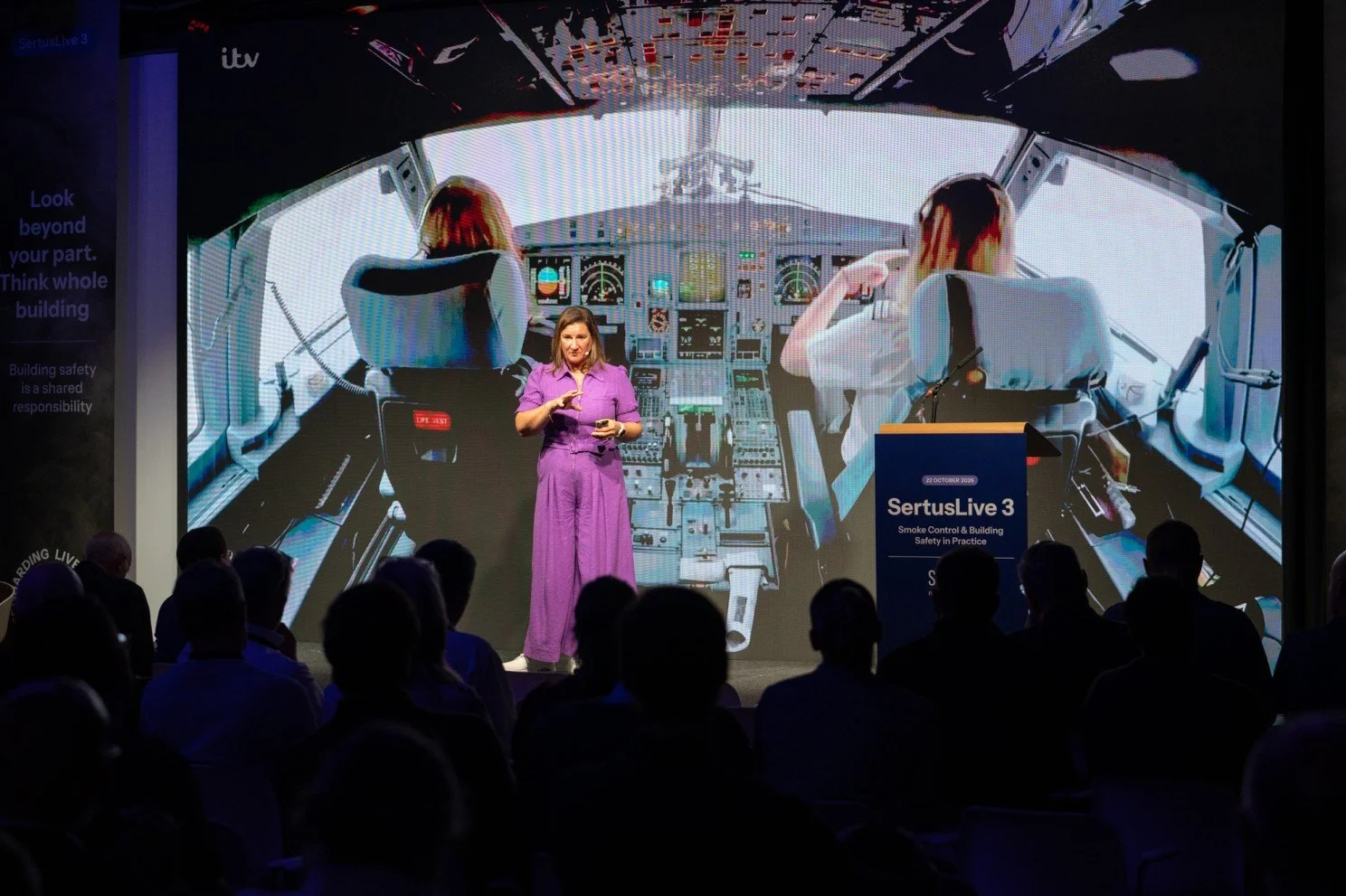
Taking the conversation about safety, leadership and Just Culture to the construction supply chain at Sertus Live.
Construction sees the same pattern on a smaller scale every day. A project passes between design, procurement and the people actually carrying out the work. The design may meet its specifications, the materials may have been purchased within budget, and the work may be progressing against schedule. What happens if the assumptions made by one group aren’t understood by the next? What if someone on site can see that a procedure isn’t working as intended, but doesn’t believe that raising the issue will lead to anything changing?
“A process can be compliant on paper while the reality on the ground tells a very different story, and this is where culture becomes more than a statement of organisational values.”
In aviation, we can't and don’t rely on the hope that important information will somehow find its way to the right person. We build opportunities for it to surface. We brief, we cross-check, we challenge, and we update each other when circumstances change, recognising that the information available at the beginning of an operation may not be the information we need halfway through it.
That doesn’t mean everyone needs to be copied into every email or invited to every meeting. Information overload can obscure a problem just as effectively as a lack of information. The skill is recognising what needs to be shared, with whom, and when.
I often think about the difference between passing information and creating understanding. You can send an email, produce a report or update a dashboard, but have the people making the next decision understood what has changed and why it matters? Have you given them an opportunity to challenge an assumption? Has anyone asked whether all the individual decisions still add up to the result you actually want?
Those are questions of leadership, not administration.
The view from 37,000 feet
One of the privileges of flying an aircraft is the perspective it gives you, quite literally, but the view from 37,000 feet doesn’t tell you everything. You need instruments, forecasts, reports and the experience of the people around you to turn that view into useful understanding.
I believe that leadership is not really that different. Senior leaders are often encouraged to take the helicopter view, and there’s value in that, but a strategic view without an understanding of what is actually happening throughout the organisation can be dangerously incomplete. Equally, the people closest to the work may understand their immediate environment brilliantly but have little visibility of the wider consequences of their decisions. Neither of those perspectives is sufficient on its own.
Good leadership is what connects everything together. It makes it possible for someone at the sharp end to explain what is happening without having to fight through layers of hierarchy, and for the people setting direction to explain not just what needs to happen, but why. It also recognises that the picture keeps changing. An effective briefing at 9am doesn’t guarantee everyone will still have the same understanding at 3pm, and if the shared picture isn’t updated, people can carry on confidently executing a plan that no longer reflects reality.

This section appears in every issue: a real-world situation that comes up again and again, and a way of thinking it through that brings it back to the centreline
A practical leadership dilemma, viewed through the flight deck.
“My department heads are all good at their jobs, but they seem to operate independently. Everyone tells me their team is performing well, but we keep encountering problems at the handover points. How do I get them working together without creating endless meetings?”
I would begin by changing the conversation. Rather than asking each department head to report on what their team has achieved, ask them to explain what their team needs from the others to succeed. It’s a subtle difference, but it shifts attention away from individual activity and towards the shared outcome.
Then I’d look at where the handovers are failing. Who knows something that somebody else needs to know? Where are assumptions being made? What information is arriving too late to be useful? Which problems keep recurring because everyone believes they belong to another department?
I would also resist the temptation to solve this by introducing another layer of reporting, because more information isn’t necessarily better information. On the flight deck, a good briefing is not an exercise in telling everyone everything you know. It’s about making sure the people involved understand the plan, the relevant risks, what might change and what we will do if it does.
I would encourage your department heads to approach their work in the same way. Start with one shared outcome, identify the critical dependencies between teams and agree what information must cross those boundaries. Then make it safe for somebody to say, “Hang on, that doesn’t fit with what I’m seeing.”
“If your teams are all doing their jobs well but the organisation is still experiencing repeated handover failures, the answer probably isn’t to make each department work harder. It’s to help them work together differently.”
Before the next decision
Last month, in How Do You Keep Good Looking Good?, I explored what it takes to sustain good performance rather than treating a successful beginning as a guarantee of continued success. There’s a connection between that idea and this month’s subject, because you can’t sustain a standard that people understand differently.
Perhaps the most useful question a leader can ask isn’t, “Has everyone done their job?” It’s something rather more demanding.
“Everyone has done their part, but has anyone checked that the parts work together?
”
That’s the question I wish we had asked earlier that morning in Luton, and in Berlin too, if I’m honest. It wasn’t that the people involved lacked skill, effort or commitment, they had all three. We simply needed to look beyond the problem immediately in front of us and remember what the whole operation was supposed to achieve.
It’s worth considering where that might be happening in your own organisation. Where are good people working hard, producing good results and still missing something important because the information hasn’t joined up? Who is responsible for making sure it does?
Keeping people with you when the picture changes is at the heart of what I call Cockpit Culture, one of the three pillars of Grounded Leadership alongside Flight Plan and The Art of Command, and it’s something I work on with leadership teams as a keynote or a workshop. If any of this sounds familiar and you’d like to explore it with your own team, send me a message and let’s talk.
No pressure or obligation. Just a place to think clearly.
Next month in A Full Capacity Bucket Has No Spare Capacity, I’ll be looking at what happens when people and teams are running at full stretch, and why there’s nothing left for the moment the plan changes.
Until next time, keep it on the centreline.