
What keeps you steady when the pressure is on?
Not when things are going well, and not when you’ve got the luxury of time. I mean when the decision matters, when people are watching, and when whatever you choose is going to have consequences that don’t just disappear the next day.
This newsletter is about that exact moment, and how not to flinch.
In aviation, we rely on something very simple. The centreline.
It’s painted on every runway and every taxiway, and we follow it every single time. We taxi on it, we take off on it, we land on it. And when we leave one, it’s only ever to join another.
It’s not there to restrict us. It’s there to keep us aligned, particularly at the moments where small deviations can quickly become something much bigger.
When you’re accelerating down a runway at speed, even a slight drift left or right doesn’t stay small for long. The margin for error narrows quickly, and the consequences of getting it wrong increase just as fast. So you stay on the centreline. Not because you can’t think for yourself, but because you understand what happens if you don’t.
I didn’t think much about it when I was flying. It was just part of the job. But looking back now, after more than 30 years of making decisions in high-pressure environments, I can see that it represents something much bigger.
Why hard decisions really feel hard
The hardest decisions I ever made weren’t difficult because they were unclear. They were difficult because they mattered. They were visible. They carried weight. And once they were made, they couldn’t be undone or quietly retracted.
That changes how you think. It sharpens your awareness, but without a way of steadying yourself, that awareness can quickly turn into noise.
That’s what I see now when I work with leaders.
Leadership without a painted line
In business, there isn’t a painted line. There’s no runway stretching out ahead of you telling you exactly where to point. Instead, there’s pressure from multiple directions, competing opinions, shifting priorities, and an expectation to move quickly.
It’s no surprise that even very capable people start to drift.
Not dramatically. Not in a way that’s immediately obvious. But just enough.
Rushing decisions to relieve pressure. Second-guessing themselves because the room isn’t aligned. Reacting to urgency rather than stepping back to think.
It doesn’t look like failure. In fact, it often looks like action. But over time, that slight misalignment compounds.
The issue isn’t that leaders don’t know what they’re doing. It’s that, in the absence of something steady to come back to, thinking becomes reactive rather than deliberate.
That’s what I mean by centreline.
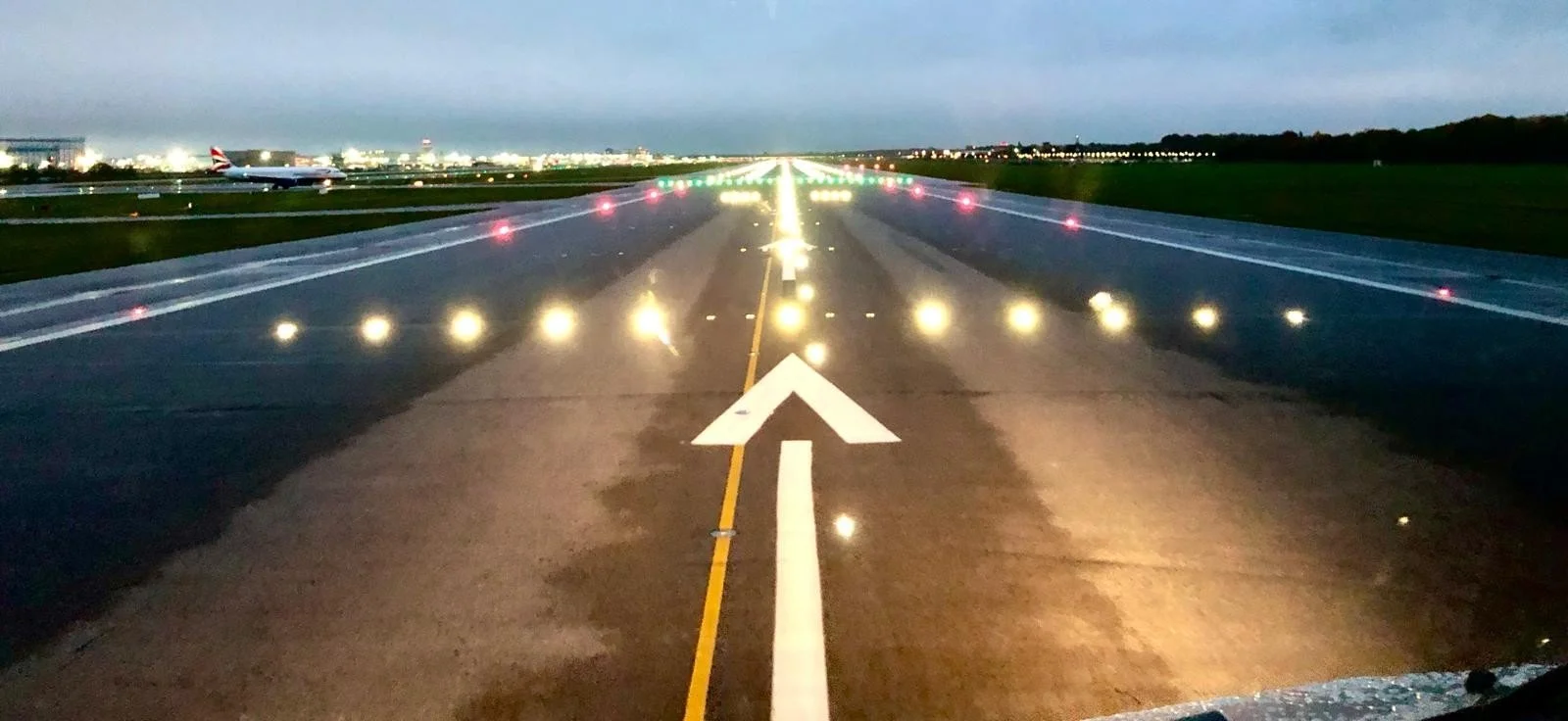
View from the cockpit as we follow the runway centreline at Gatwick.
Not a rigid process or a checklist, but a way of thinking that holds when things get difficult. Something that keeps you aligned when everything around you is speeding up.
Because when pressure increases, people don’t suddenly rise to the occasion. They fall back on what they know and what they trust.
And if what they trust is speed, then speed is what they default to.
Speed on its own isn’t what creates good decisions. In fact, it’s often where drift begins.
The leaders who stand out aren’t necessarily the ones with all the answers. They’re the ones who stay steady. You can see it in how they operate. They pause, even when things are moving quickly. They ask better questions. They don’t get pulled in every direction at once. They stay aligned to something, even when that something isn’t visible to everyone else in the room.
That’s what this newsletter is about.
Not adding more noise, and not giving you more theory to wade through. It’s about how to think clearly when clarity isn’t handed to you, and how to stay grounded when the pressure to move quickly is at its highest.

Dial-Emma: When you’re under pressure to decide
This section will appear in every issue: a real-world situation that comes up again and again, and a way of thinking it through that brings you back to centreline.
Scenario
You’re under pressure to make a decision. Your instinct is pulling you one way, your team is split, and someone senior wants an answer quickly. You can feel the tension building. If you take more time, you risk looking indecisive. If you move too quickly, you risk getting it wrong.
This is exactly the moment to slow your thinking down, not speed it up.
Four questions to bring you back to centreline:
What actually needs deciding today?
What is my instinct based on?
What might I be missing?
Can I stand behind this decision tomorrow?
Leadership is rarely about perfect decisions. It’s about defensible decisions made with clear thinking.
That’s the centreline.
What we’re building here
There’s no painted line in leadership. But there is a way of thinking that keeps you aligned when everything around you is trying to pull you off course.
Centreline is where I’ll share short reflections and Dial-Emma scenarios to help you stay steady when the stakes are high, time is limited, and certainty isn’t available.
If this resonated, subscribe to Centreline so you don’t miss the next issue. And if you know someone who’s sitting with a difficult decision this week, forward this to them and ask:
“Where’s your centreline in this?”
I work with leaders and organisations to apply this kind of thinking to live, high-stakes decisions when clarity matters most. If this sounds like something your next event needs lets explore working together.
No pressure or obligation. Just a place to think clearly.